keskiviikko 21. helmikuuta 2018

ANBO VIII

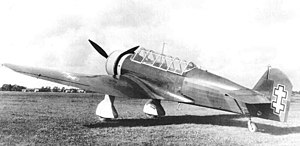
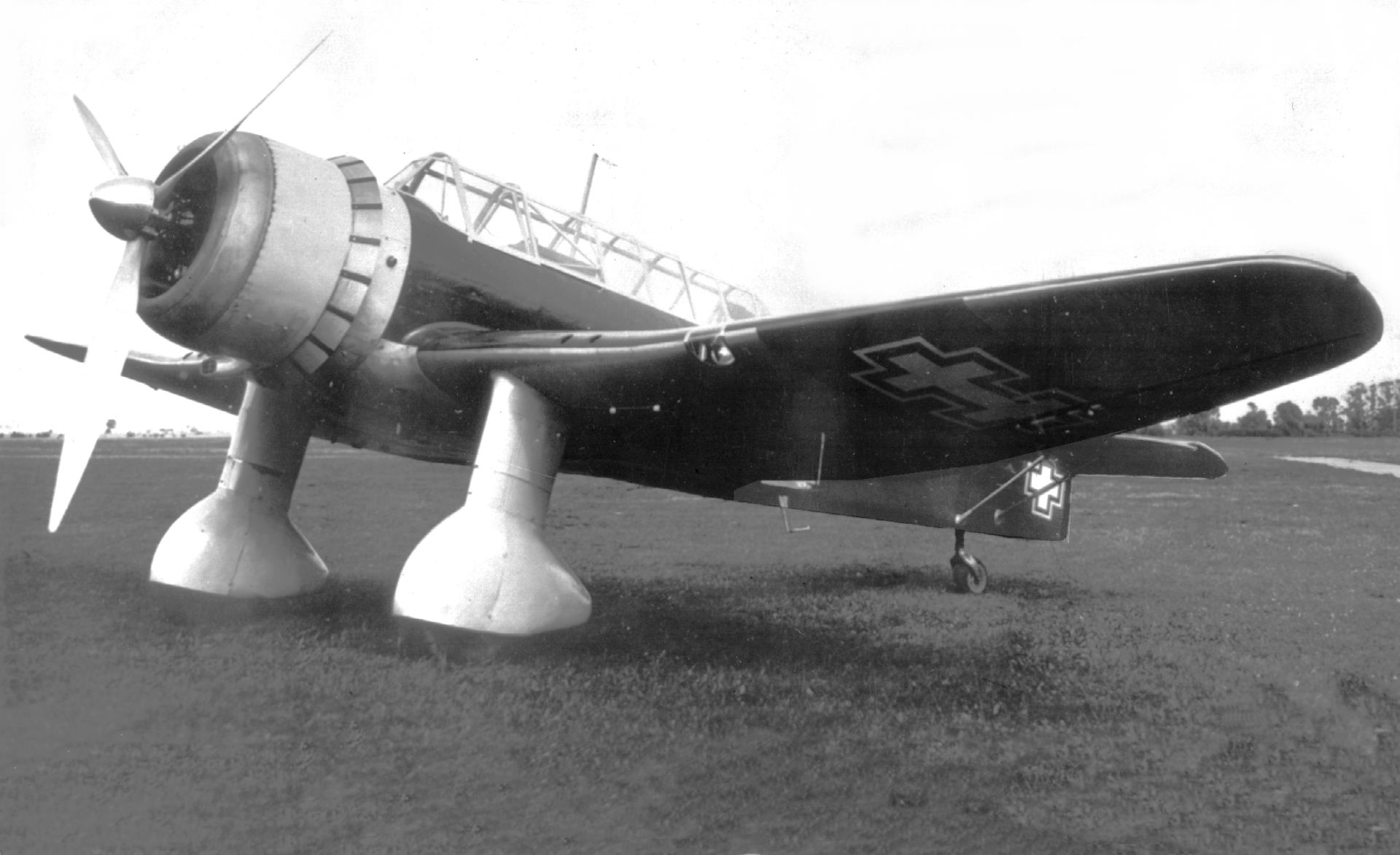
The ANBO VIII was a Lithuanian bomber-reconnaissance monoplane designed by Antanas Gustaitis and built by Karo Aviacijos Tiekimo Skyrius.

The ANBO VIII was a low-wing monoplane with a tailwheel landing gear, an enclosed two-seat tandem cockpit and powered by a 930 hp (694 kW) Bristol Pegasus XVIII radial engine. 
                Anbo8.jpg
The prototype and only ANBO VIII was first flown on 5 September 1939 and was still under testing when the country was annexed by the Soviet Union. 

The prototype was removed by the Soviet authorities for testing.
                Kuvahaun tulos haulle ANBO VIII

                Kuvahaun tulos haulle ANBO VIII

                Kuvahaun tulos haulle ANBO VIII

General characteristics
Number built: 1
Crew: 2
Length: 9.5 m 
Wingspan: 13.5 m 
Wing area: 30 m2 
Empty weight: 2,300 kg 
Max takeoff weight: 3,700 kg 
Powerplant: 1 × Bristol Pegasus XVIII radial piston engine, 690 kW (930 hp)
Maximum speed: 411 km/h  at 5,000 m altitude
Minimum control speed: 113 km/h 
Service ceiling: 9,000 m
Time to altitude: 2 minutes to 1,000 m, 15 minutes to 5,000 m 
Guns: 4 × 7.7 mm  fixed forward-firing M1919 Browning mg with 500 rpg
1 × 7.7 mm  manually aimed M1919 Browning mg in the rear cockpit with 5 x 100 round boxes
Bombs: up to 600 kg on a fuselage bomb rack and/or 400 kg under the wings.
Operator: Lithuania

torstai 15. helmikuuta 2018

Edgar O. (Ed) Schmued

Edgar O. (Ed) Schmued (Schmüd), German-American aircraft designer (1899–1985) was famed for his design of the iconic North American P-51 Mustang and, later, the F-86 Sabre while at North American Aviation. He later worked on other aircraft designs as an aviation consultant.

Edgar Schmued was born in Hornbach, Germany, 30 December 1899. At the age of eight, he first saw an airplane in flight and decided that aviation was to be his life's work. Edgar embarked early on a rigorous program of self-study to become an engineer, and later served an apprenticeship in a small engine factory. He also designed several innovative engine components for which he received patents. In his spare time, he continued the self-study of aviation. Schmued left his native Bavaria for Brazil in 1925, seven years after World War I had shattered the German economy. 

His experience in Germany led to employment with the General Aviation, the air branch of General Motors Corporation in Brazil. In 1931, he was sponsored to move to the United States through his excellent work for General Motors in Brazil (immigration rules were extremely strict at that time - he was one of 794 people admitted in the quota) and went straight to work for Fokker Aircraft Corporation of America, which was an aircraft company that was owned by General Motors and based in New Jersey. There he began his career as an aircraft design engineer. General Motors later sold its air arm and it became the forerunner of North American Aviation.
The talented and inventive Schmued, by now a citizen of the United States, was employed by North American Aviation (NAA) in Dundalk, Maryland. In 1935, North American was relocated to Los Angeles, California, from General Motors. When his wife Luisa proved reluctant to relocate from the east coast, Schmued joined Bellanca but his time there was short-lived. While traveling to California to work again for North American, the Schmueds were involved in a head-on collision on Route 60. Schmued's wife was killed, while he himself was seriously injured.

North American Aviation
After recovering, Schmued went to work for "Dutch" Kindelberger in early 1936 as a preliminary design engineer. He was involved in the XB-21 (designing the front turret), creating the NA-50 single-engine fighter for Peru then going on to design work on the NA-62 (later the B-25 Mitchell). Schmued later became Chief of Preliminary Design.


During his long tenure at NAA, Schmued contributed greatly to the design of many airplanes. By far his most famous design was the highly successful P-51 Mustang of World War II. The legend began with NAA's President, "Dutch" Kindelberger asking, "Ed, do we want to build P-40s here?" Schmued had been long awaiting a question like this. His answer began the design process, "Well, Dutch, don't let us build an obsolete airplane, let's build a new one. We can design and build a better one." 

His adaptation of the then new laminar flow wing and other innovations made the P-51 performance outstanding in all respects and its flying qualities superb. This aircraft was still winning races and setting speed records for piston engine-powered airplanes decades after its production had ended. Although he was renowned as a workaholic at North American, Schmued undertook the design of the Morrow Victory Trainer in 1941 on an independent contract; it was dubbed the "Mini-Mustang" because of its close resemblance to the P-51.

Fueled by a striking similarity of the early Mustang and the German Messerschmitt Bf 109 - pilots and ground crews of both sides confused the two aircraft - and Schmued's German origin, an urban legend has grown up, claiming he had once worked for Willy Messerschmitt and that the Mustang was heavily influenced by the Bf 109. Neither claim is true but the urban legend persists. 

Schmued's team at NAA did receive, disassemble and inspect the first captured Bf 109 from the Spanish Civil War in 1939, and he regularly received copies of German Aeronautical Engineering Journals through 1941 supplied by Jim McGowan, ALCOA's consulting sales engineer. Just as familiar is the notion that the abortive Curtiss XP-46 was the basis of the P-51 design.

Schmued was employed by North American Aviation, later a division of the Rockwell International Corporation, for 22 years. During his tenure, Schmued also designed the F-82 and, the other iconic NAA designs, the F-86 Sabre and F-100 Super Sabre.
                                                          A36 A


Northrop and later years
After leaving North American in August 1952, Schmued spent five years as Vice President of Engineering for the Northrop Corporation. At Northrop he recruited a top engineering team he used to develop the successful F-5 supersonic light fighter and the closely related T-38 trainer. 

For these aircraft Schmued emphasized not only performance, but simplicity, safety, low cost, and long service life. The resulting F-5 was not only the most cost effective U.S. supersonic fighter, but likely also the most combat effective U.S. air-to-air fighter design in the 1960s and early 1970s. The well regarded and long lived F-5 and the 
T-38 aircraft remain in active service as of 2014. 

The F-5 serves as an adversary aircraft for the U.S. Air Force and Navy in fighter combat training, as well as a front line fighter in the air forces of more than 20 nations. The T-38 has served as the primary advanced/supersonic trainer for the U.S. Air Force for more than 50 years, a record unequaled by any other aircraft of this class.

Edgar Schmued continued his aircraft design work as an independent consultant following his retirement from Northrop in October, 1957. He consulted for the U.S. Department of Defense, allied nations, for private companies, and for the film industry making aviation related movies. He worked actively until shortly before his death on 1 June 1985.

Any damned fool can criticize, but it takes a genius to design it in the first place.

— Edgar Schmued, Chief Designer North American Aviation

maanantai 12. helmikuuta 2018

Dux Factory

Dux (Russian: Завод «Дукс», translit. Zavod "Duks") was a bicycle / automobile / aircraft factory in Moscow, Russia before and during World War I.

The factory was founded in 1893. The name comes from the Latin word dux (leader). Y. A. Meller was owner of the factory which was primarily focused on the building of French aircraft designs.
                Kuvahaun tulos haulle pao Dux

The majority of types built by Dux were French and other Western aircraft designs. The first aircraft made was a licensed Farman IV with ENV engine, which made its first flight on August 18, 1910. From there, in addition to copies, some improvements were designed for existing models. The first of these was a Farman VII in 1912 with some improvements that were put into production. 

A more ambitious project was the Dux Meller I which combined a Bleriot main fuselage with a Farman XV nacelle added, all driven by a 100 hp Gnome-Rhone in pusher configuration. A modified Farman XVI was later produced under the name Dux Meller II and flown in 1913. 

The following Dux Meller III was a failed attempt to produce a single-engine twin-propeller chain-driven monoplane. Further work went into the Dux No 2 but this was also a failure. While engineering continued on a new twin engine pusher, in the end the factory's primary activity was construction of Western designs.
--------------
PAO Dux
AO
IndustryAerospace
FateNationalized, later reinstated as a private company
Founded1893
HeadquartersMoscowRussia
Key people
Julius MellerMukhtar Mejidov
ProductsAircraft components, Missiles,
Military aircraft
Websitewww.duks.su
Many of the Moscow-based plants of the former Dux Factory were evacuated in 1941 and went on to become separate companies. The Dux factory gave the origin to many production institutions, among which are some worldwide recognized firms.

The factory was established in Moscow in 1893 as a bicycle production plant. Production shifted to aircraft manufacturing in 1910. During World War I Dux produced Voisin LAS, Nieuport 17, Nieuport 24, Farman family of aircraft including models IV, VII, XVI, XXX, as well as a large number of military bicycles.

After the October Revolution the plant was named "Aircraft plant #1 named after OSOAVIAKHIM" or "GAZ No. 1". Farmans and Nieuports were left in production.
                Kuvahaun tulos haulle pao Dux
                Kuvahaun tulos haulle pao Dux

                Kuvahaun tulos haulle pao Dux
In 1923 a design bureau was established at the plant, headed by Nikolai Nikolaevich Polikarpov; this would later become known as the Polikarpov Design Bureau.


Production models included I-5, I-15, I-15bis, I-153, I-16, R-5, and R-Zet aircraft. Polikarpov also built Airco DH.9A (which later became Polikarpov R-1/Polikarpov R-2) and Airco DH.4 during the 1920s and 1930s.

Plant #1 produced the MiG-3 before evacuation in October 1941. Plant #1 was evacuated to Samara in 1941, becoming the Kuibyshev Aviation Plant. In 1958 it shifted its production to rockets, and became known as the Samara Progress plant.

Main article: Moscow Aircraft Production Association
Plant #30 was established in 1939 in Dubna. In December 1941 it was relocated to the former site of Plant #1, where it manufactured the Ilyushin Il-2. 
In 1950 it merged with Plant #381, to produce the Il-28 in larger volumes. 
In 1953 Lukhovitsy Machine Building Plant was established as a subsidiary of the plant.

Plant #30 became known as the Znamya Truda Machine-Building Plant in 1965,
and as the Moscow Aircraft Production Organisation in 1973.

The MiG-29 was put in production. Civil programs include MiG-AT, T-101, T-411, and Aviatika MAI-890 aircraft. After this the following aircraft were produced: Su-9, Yak-25, Il-14, Il-18 with modifications, MiG-21, and MiG-23.

Plant #32 was established in 1932, when it was separated from Plant #1.[1] In 1941 it was evacuated to Kirov, becoming the Kirov Machine-Building Plant in 1960 and the Vyatka Machine Building Enterprise AVITEK in the 1990s.

Plant #39 produced the DB-3F before evacuation in October 1941. Plant #39 was moved to Irkutsk in 1941, where it was merged with the Irkutsk Machine-Building Plant, ultimately establishing the Irkutsk Aviation Plant.

Main article: Moscow Kommunar Machine-Building Plant
Plant #43 was established in 1941 on the former site of the evacuated Plant #32. Between 1963 and 1992 it was known as the Moscow Kommunar Machine-Building Plant. It focuses on air-to-air missile production and some aircraft sub-components. In 1992 it became the Open Joint Stock Company Dux.

Plant #381 produced the La-5 and later the La7. Plant #381 also produced the Il-12, a small series of I-250, and the first 75 of MiG-15. In 1950 it was merged into Plant #30.


Loening OL

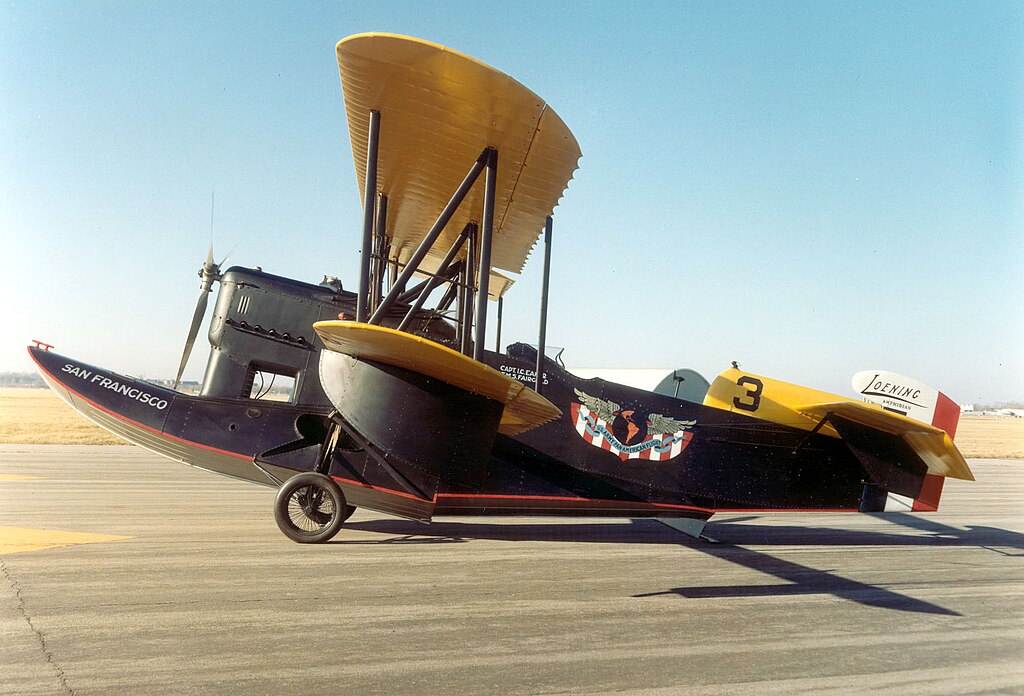
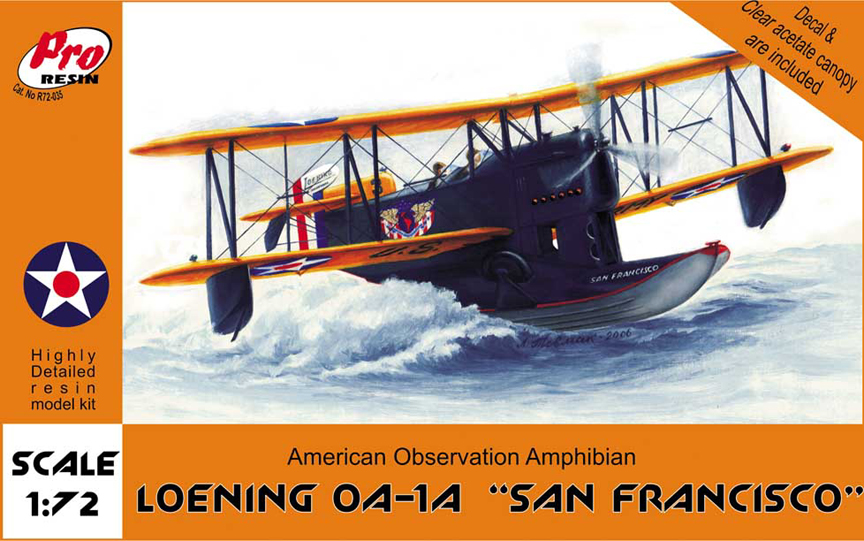
The Loening OL, also known as the Loening Amphibian, was an American two-seat amphibious biplane built by Loening for the United States Army Air Corps and the United States Navy.

First flown in 1923, the OL was a high-performance amphibian with a large single hull and stabilizing floats fitted underneath each lower wing. The landing gear was retractable by use of a hand crank in the cockpit, and the plane was equipped with a tailskid for operations on land. It had a tandem open cockpit for a crew of two. The aircraft could be flown from either cockpit, with a wheel control in the forward cockpit and a removable stick control in the rear. Navigation and engine instruments were located in the forward cockpit.

                
General characteristics
Crew: two
Length: 10.59 m
Wingspan: 13.72 m
Height: 3.89 m
Wing area: 46.82 m2
Empty weight: 1655 kg
Gross weight: 2451 kg
Powerplant: 1 × Pratt & Whitney R-1340-4 Wasp radial piston engine, 450 hp (336 kW)
Maximum speed: 196 km/h
Range: 1006 km
Service ceiling: 4360 m

                Loening OA-1A USAF.jpg
The hull was built of Duralumin on a wooden frame, with five watertight compartments connected through a selector switch to a bilge pump in the rear cockpit. Plugs in the bottom of each compartment permitted drainage on the ground. The fuselage was constructed on top of the hull. The aircraft was strength-tested at Columbia University.
                Kuvahaun tulos haulle Loening OL
The United States Army Air Corps ordered four prototypes as the XCOA-1, powered by a 400-hp Liberty V-1650-1 engine mounted inverted for clearance of the three-bladed variable-pitch steel propeller. The engine came with a fire suppression sprinkler system and was encased in a streamlined cowling to protect it from sea spray. Oil from a tank in the fuselage was cooled by passing through a spiral copper tube exposed to the slipstream on top of the cowling. 

The fuel tanks were mounted inside the hull, with a 530-liter gasoline tank under the wings, and a reserve 230-liter gasoline-benzol tank between the cockpits. Total fuel capacity provided for roughly ten hours of flight.

A number of variants were introduced for both the Army and the Navy. During later production, the company merged with the Keystone Aircraft Corporation.
               Kuvahaun tulos haulle Loening OL

sunnuntai 11. helmikuuta 2018

At series: once upon a time

Thunderbirds is a British science-fiction television series created by Gerry and Sylvia Anderson, filmed by their production company AP Films (APF) and distributed by ITC Entertainment. It was produced between 1964 and 1966 using a form of electronic marionette puppetry (dubbed "Supermarionation") combined with scale model special effects sequences. 
Two series were filmed, comprising a total of thirty-two 50-minute episodes; production ceased following the completion of the second series' sixth episode when Lew Grade, the Andersons' financial backer, failed in his efforts to sell the programme to American network television.


---------------
Myrskylinnut (engl. Thunderbirds) oli Gerry Andersonin ja Sylvia Andersonin luoma 1960-luvun televisiosarja, joka käytti supermarionaatioksi kutsuttua nukkeanimaatiotyyliä. Sarjaa tehtiin vuosina 1964–1966 yhteensä 32 jaksoa. Tulevaisuuteen sijoittuva sarja kertoo kansainvälisestä pelastuspartiosta, jolla on käytössään erilaisia lentäviä kulkuneuvoja. Hahmot esiintyivät myös kahdessa pitkässä elokuvassa: Thunderbirds Are Go! (1966) ja Thunderbird 6 (1968). 
Sarjan tunnusmusiikin on säveltänyt Barry Gray.

Suomessa Myrskylintuja on esitetty Yle TV2 -kanavalla keväällä 1966 ja syksyllä 1973[1], myöhemmin Kolmoskanavalla, MTV3:lla ja SubTV:llä. Vuonna 2008 Myrskylintuja esitettiin maksullisella MTV3 Scifi -kanavalla.

Vuonna 2004 Jonathan Frakes ohjasi sarjaan perustuvan Myrskylinnut-elokuvan oikeilla näyttelijöillä. Elokuva ei menestynyt taloudellisesti tai kriitikkojen parissa.
---------------
Thunderbirds TV-series Full story

Set in the mid-2060s, Thunderbirds is a follow-up to the earlier Supermarionation productions Four Feather Falls, Supercar, Fireball XL5 and Stingray. It follows the exploits of International Rescue (IR), a life-saving organisation equipped with technologically-advanced land, sea, air and space rescue craft; these are headed by a fleet of five vehicles named the Thunderbirds and launched from IR's secret base in the Pacific Ocean. The main characters are ex-astronaut Jeff Tracy, the founder of IR, and his five adult sons, who pilot the Thunderbird machines.
Thunderbirds began its first run in the United Kingdom on the ITV network in 1965 and has since been broadcast in at least 66 other countries. Periodically repeated, it was adapted for radio in the early 1990s and has influenced many TV programmes and other media. As well as inspiring various merchandising campaigns, the series has been followed by two feature-length film sequels (Thunderbirds Are Go and Thunderbird 6, released in 1966 and 1968 respectively), a 2004 live-action film adaptation and a mimed stage show tribute. The second of two TV remakes, the computer-animated Thunderbirds Are Go, premiered in 2015, in honour of the original show's 50th anniversary.


Widely considered to be the Andersons' most popular and commercially successful series, Thunderbirds has received particular praise for its effects (directed by Derek Meddings) and musical score (composed by Barry Gray). It is also well remembered for its title sequence, which opens with an often-quoted countdown by actor Peter Dyneley (who voiced the character of Jeff): "5, 4, 3, 2, 1: Thunderbirds Are Go!"
A real-life rescue service, the International Rescue Corps, is named after the organisation featured in the series.

perjantai 9. helmikuuta 2018

Frank Tinker

Frank Glasgow Tinker (July 14, 1909 – June 13, 1939) was an American volunteer fighter pilot for the Fuerzas Aéreas de la República Española ("Air Forces of the Spanish Republic"; FARE), during the Spanish Civil War.

Tinker was credited officially with shooting down eight enemy aircraft and was the highest-scoring American air ace of the war. However, Tinker's logbook suggests that he claimed 19 victories, which would make him the sixth-highest scoring pilot in FARE. That relatively few of his claims were officially recognized was due to the complex system of verifying air kills used by FARE and the financial incentive paid to mercenaries: many victories were not verifiable because the downed aircraft crashed in an enemy-held area and/or a incentive would not have to be paid. 

                Kuvahaun tulos haulle Escuadrilla de Chatos

In addition, Tinker and other pilots from Escuadrilla La Calle ("La Calle's Squadron"), also known as 1ª Escuadrilla de Chatos (1st Chato Squadron"), shared a number of joint kills against Junkers Ju 52 bombers. He reported narrowly avoiding death at both the hands of enemy aviators and malfunctioning equipment.

Frank "Salty" Tinker was born in Kaplan, Louisiana, and grew up in DeWitt, Arkansas. In 1926, he joined the US Navy hoping to become a naval aviator. In 1933, he graduated from the US Naval Academy. In 1934, he was assigned to US Navy aviation and became a pilot of a reconnaissance floatplane of the USS San Francisco cruiser. Because of problems with alcohol and brawls, he was dismissed from the Navy.

Later in 1935, Tinker joined the crew of a Standard Oil tanker running from New York to Baton Rouge, Louisiana, as a third mate. By July 1936, he left his job with Standard Oil, and looked for a job as a pilot.

After the start of the Spanish Civil War, Tinker offered his service to a Republican side, reportedly because of his aversion to fascist regime of Benito Mussolini, who was helping the Spanish Nationalists. He negotiated a high salary of $1,500 monthly, and a premium of $1,000 for any aircraft he shot down. Under nom de guerre Francisco Gómez Trejo, he went to Spain via France.
For a short time, from January 6, 1937, Tinker served in a light bomber squadron, flying obsolete Breguet 19 bombers. From January 23, he, along with some other American pilots, was assigned to a fighter unit, 1st Escuadrilla de Chatos commanded by Andrés García La Calle, flying Soviet Polikarpov I-15 "Chato" biplanes. In 1937, he flew many combat missions against the Fascist Falange air forces, generally duelling Germans and Italians. 

The squadron first entered action on February 10, and took part in a Battle of Guadalajara. On March 14, Tinker shot down his first aircraft, an Italian Fiat CR.32 fighter, followed by another CR.32 on March 20. On April 17, he shot down a German Heinkel He 51 fighter from Legion Condor over Teruel.

On May 3, 1937, Tinker was assigned to 1st Escuadrilla de Moscas, commanded by the Russian, Ivan Lakyeyev, flying the faster Polikarpov I-16 "Mosca" monoplane fighters. On June 2 and June 16, he shot down another CR.32.                       Tinker >>>
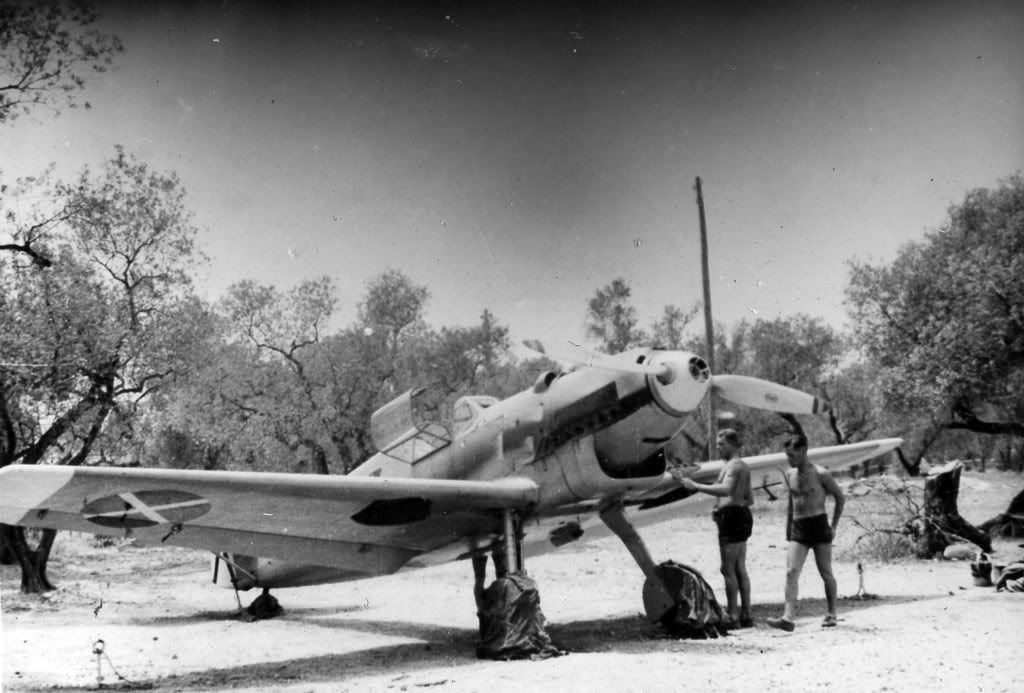
On July 13, he became the first pilot to shoot down one of the most modern German fighters, a Messerschmitt Bf 109A, near Madrid. It was piloted by Unteroffizier Guido Honess of 2. Staffel/Jagdgruppe 88 (2./J 88), flying a Bf 109A believed to be marked 6-4. Honess, who was killed in the ensuing crash, was the first German pilot to achieve three victories with this new type of aircraft. 

                 Kuvahaun tulos haulle spanish civil war me 109 A
On July 17, Tinker shot down another Bf 109A. 
                                                       Me 109B
This first version of the Bf 109 was not a "good climber" and Tinker caught it from behind while the German pilot tried to gain altitude after a dive on him – a lethal mistake according to Tinker. The scene is described in detail in his book Some Still Live. His final victory was over a Fiat CR.32 on July 18, 1937. Tinker flew his last missions on July 29, 1937,   then returned to the U.S.

While in Spain, Tinker socialized with Ernest Hemingway, Robert Hale Merriman, the leader of the American Volunteers of the Lincoln Brigade and his successor Milton Wolff, who led the 15th International Brigade during the Battle of the Ebro.           

Eventually, Tinker fell victim to combat stress reaction due to the constant combat. After the war, Tinker was a guest speaker in New York on the radio program "We the People", discussing his feats in the Spanish Civil War. He wrote a number of articles including a series for the Arkansas Gazette Magazine describing his voyage from St. Charles (Arkansas County) down the White and Mississippi rivers to New Orleans with his fox terrier. 


Tinker also wrote a series of serial articles for the Saturday Evening Post titled "Some Still Live". These articles detailing his war experiences, were published in book form with the same name in 1938. Ernest Hemingway was notably a fan, lauding it to Maxwell Perkins. Hemingway's influence on the style is rather evident.

However, soon after the book was published, Tinker died, a purported suicide by a gunshot to his head in a Little Rock hotel .

The reasons for his death are still controversial and may relate to the harsh treatment he received from the FBI, due to his support of the Spanish Republican cause. Tinker asked to return to the U.S. Navy or U.S. Army as a pilot but he was rejected. He even threatened to return to Spain to continue fighting. At the end, he was haunted by the thought he had betrayed his comrades and himself. 
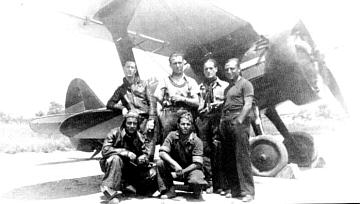
          The I-15 Polikarpov No. 56 flown by F.G. Tinker in the 1st Sq Lacalle. 
He scored four victories in this aircraft. Occasionally he flew No. 58 as well.                                                    
     The I-16 Polikarpov No. CM-023 flown by F.G. 
Tinker in the 1st Sq Moscas with which he shot down two German Bf 109Bs.
His colleague Albert John Baumler, nicknamed "Ajax" (from his name acronym A.J.), proposed joining the American and other foreign pilots then flying for the Chinese Nationalist Air Force. His signed request was found next to his death bed with an empty bottle of whiskey. On his tombstone, the local priest engraved the phrase in Spanish: ¿Quién Sabe?, meaning "Who knows?"

Arkansas Aviation Historical Society inducted Tinker into the Arkansas Aviation Hall of Fame in 1999.

On July 11, 2009, near the centennial of his birth, relatives, admirers and the Grand Prairie Historical Society participated in an observance and toast at Tinker's gravesite in DeWitt, Arkansas.

torstai 8. helmikuuta 2018

Focke-Achgelis Fa 330 Wagtail

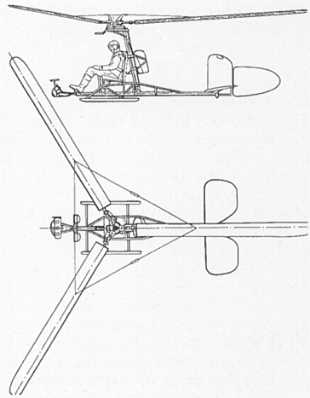
The Focke-Achgelis Fa 330 Bachstelze (English: Wagtail) was a type of rotary-wing kite, known as a gyroglider or rotor kite. They were towed behind German U-boats during World War II to allow a lookout to see further.

Because of their low profile in the water, submarines could not see more than a few miles over the ocean. To solve this, the German admiralty considered a number of different options, including a folding seaplane (Arado Ar 231). In the end, they chose the Fa 330, a simple, single-seater, autogyro kite with a three-bladed rotor.


The Fa 330 could be deployed to the deck of the submarine by two people and was tethered to the U-boat by a 150 m cable. The airflow on the rotors as the boat motored along on the surface would spin them up. The kite would then be deployed behind the U-boat with its observer-pilot aboard, raising him approximately 120 meters above the surface and allowing him to see much farther - about 45 km, compared to the 10 km visible from the conning tower of the U-boat. If the U-boat captain were forced to abandon it on the surface, the tether would be released and the Fa 330 descend slowly to the water.

When not in use, the Fa 330 was stowed in two watertight compartments aft of the conning tower. Recovering, dismantling, and stowing the Fa 330 took approximately 20 minutes and was a difficult operation.
                              Henkilön Jouko Bruun kuva.

As Allied air cover in other theatres of the war was considered too much of a threat, only U-boats operating in the far southern parts of the Atlantic and the Indian Ocean used the Fa 330. Despite its advantages, the use of the Fa 330 resulted in only a single sinking when U-177 used one to spot, intercept and sink the Greek steamer Efthalia Mari on 6 August 1943.

The Allies came into possession of an Fa 330 in May 1944 when they captured the U-852 intact. After the war, the British government did successful experiments towing Fa 330s behind ships and jeeps, but the development of the helicopter quickly occupied the attention of the military.

U-boats that deployed Fa 330 kites included at least U-177, U-181, and U-852. Otto Giese wrote, "Our boat was rigged with a Bachstelze. This was a small, single, piloted helicopter attached to a long steel cable and lifted into the air by the speed of the boat while the cable was gradually reeled out. From his position aloft, the pilot had a 360-degree view and could report any vessels.

In February 2013, Aviation Week and Space Technology reported that L-3 Communications was testing its Valkyrie, an unpowered, tethered autogyro that weighs 95 kg, which is intended to serve as a cheap alternative to a shipborne helicopter. Valkyrie is designed to hover as high as 1,530 meters (but is envisioned to operate typically at 150 to 300 meters), offering a 45-65 kilometer field of view. L-3 stated that naval vessels could easily be retrofitted with this system.

General characteristics
Crew: 1
Length: 4.42 m 
Empty weight: 68 kg 
Main rotor diameter: 7.32 m 
Main rotor area: 42 m2, 3-bladed rotor
Maximum speed: 40 km/h  on tow
Minimum control speed: 27 km/h on tow


tiistai 6. helmikuuta 2018

SB Lim-2

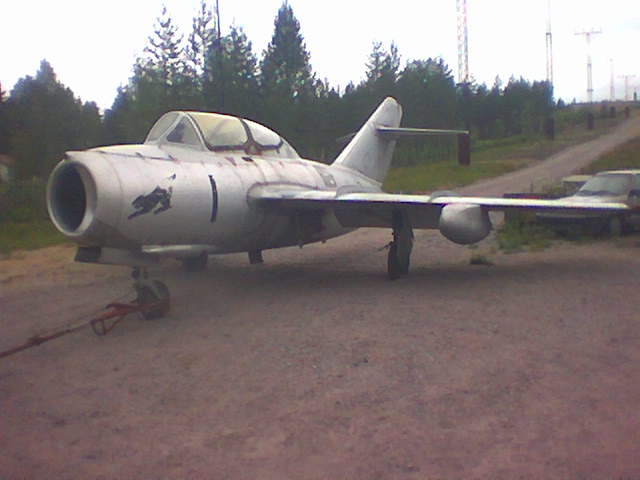
Franciszek Jarecki (born September 7, 1931 – died October 24, 2010) was a pilot in the Polish Air Force, who became famous in early 1953 when he escaped Soviet-controlled Poland in a Mikoyan-Gurevich MiG-15 jet, one of the best Soviet planes at that time.

Jarecki was born in 1931 in Gdów, a town near Kraków. His family soon moved to Stanisławów, where his father died in 1939, and in 1945 was deported by the soviets to Bytom, Upper Silesia. He was a graduate of a prestigious Polish Air Force Academy in Dęblin. Some time in the early 1950s he was moved to Słupsk in northern Poland, near the Baltic Sea. There he flew MiG-15s as a few of them were operated by the Polish Air Force.

                Kuvahaun tulos haulle SBLim-2
On the morning of March 5, 1953 (coincidentally, the day of Joseph Stalin's death), Jarecki escaped Poland in the SB Lim-2, a licenced-production version of the MiG-15UTI trainer. The decision was a very risky one, as the People's Army of Poland had previously shot those who tried to escape. For example, Edward Pytko, an instructor at Dęblin, tried to escape to Western Germany in 1952, but was stopped by Soviet aircraft over Eastern Germany and handed back to the Poles; Pytko was charged with high treason and executed. Jarecki flew from Slupsk to the field airport at Rønne on the Danish island of Bornholm. The whole trip took him only a few minutes. There, specialists from the United States, called by Danish authorities, thoroughly checked the plane. According to international regulations, they returned it by ship to Poland a few weeks later.

                 Kuvahaun tulos haulle SBLim-2
Jarecki remained in the West. From Denmark he moved to London, where General Władysław Anders awarded him the Cross of Merit, and then to the U.S.A., where he provided crucial information about modern Soviet aircraft and air tactics. Among those who shook his hand was President Dwight D. Eisenhower. Jarecki received a $50,000 prize for the person who was first to present a MiG-15 to the Americans and became a U.S. citizen.

A propaganda leaflet featuring Jarecki's story, produced shortly after his defection, encouraging North Korean pilots to defect with their jet fighters. The first to do so would get $100,000 as a reward. North Korean pilot No Kum-Sok eventually claimed the $100,000 reward for doing so in Operation Moolah

                 Aiheeseen liittyvä kuva
A few months later, another Polish pilot, Zdzisław Jazwinski escaped with a MiG-15 to Bornholm. Three years later, four students of Dęblin's school escaped in two Yakovlev Yak-18 planes, crossing Czechoslovakia to land near Vienna in neutral Austria. The leaflets used in Operation Moolah during the Korean War carried a photo of Jarecki

Jarecki lived in Pennsylvania until his death on October 24, 2010. He owned a factory in Fairview, Pennsylvania, called Jarecki Valves and Commodore Downs a local horse racing track. The uniform in which he escaped can be seen at the National Air and Space Museum in Washington, D.C. In 2006, Polish TV Station TVN made a film, Jarecki, which is part of the “Great Escapes” series. The series shows stories about Poles who escaped the country between 1944–1989 and chose freedom in the West