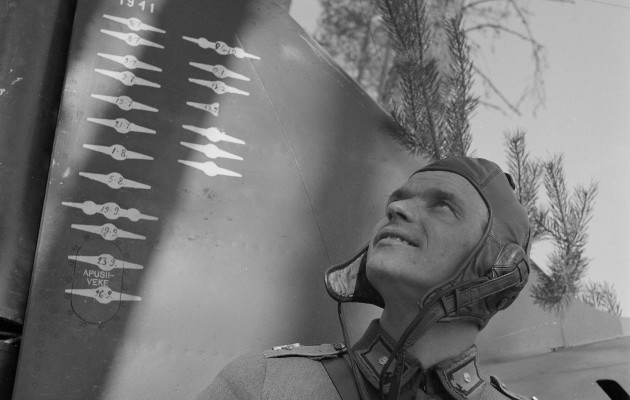
He flew in the LeLv 24 and LeLv 34 (HLeLv 34), the most successful fighter squadrons of the Finnish Air Force, often flying as a wingman for the most proficient Finnish ace Air Sergeant Master Ilmari Juutilainen. He achieved a total of 8 air victories during the wars. His highest rank during the war was Sergeant Master.
Erik Lyly was born in Ypäjä, Loimaa in Finland 1914. He completed his national service as a flight engineer at Lentosotakoulu (Air Force Aviation Academy) between 1931 and 1932. His youth was marked by the depression of the 1930s.
He, among other things, worked in the South American Line on a steamboat (1933–34). He moved then to the Petsamo region and tried his luck in many different professions. Short session as engineer on a fishing boat was followed by own taxi company at Liinahamari (1936–37). Next he took up the task assemble and build a mini-locomotive sent from England by Mond Nickel Ltd. (1937–38, Railway Engineer, Petsamon Nikkeli Oy).
----------
 Radiocall "Buck"
Erik Lyly was awarded the following honors:
4. class Cross of Liberty with leaves and swords
4. class Cross of Liberty with leaves
1. class Medal of Liberty
2. class Medal of Liberty
Memorial Medal of the Winter War
Memorial Medal of the Continuation War
Memorial Medal of the Air Force
Memorial Cross of Home Guard
Memorial Cross of Lapland Units
----------

State Aircraft Factory, summer 1941 (VL = Valmet)
Upon completion of the railway and locomotive to the Pummanki harbour he started as Service Manager for Pohjolan Liikenne Oy (state owned bus company 1938-39). While living in Petsamo, he met Sisko Seppi (POB Kauhajoki 1920) whom he married 1939, just on the eve of the Winter War. He studied at the Tampere Technical School (1939–43) at the Industrial School Engineering Department, from where he graduated as a technician in 1943 due wars fragmenting the studies.
Erik Lyly in pilot training with a VL Pyry (snowfall) trainer, summer 1941
The Winter War (Russo-Finnish War 30.11.1939-13.3.1940)
The Defense Forces performed the so-called YH, Additional Exercise (Mobilisation) in Oct 1939 and Erik Lyly was called to rehearsal exercises to a Frontier Guard unit (4./Lapin Rajavartiosto). This time performing as a military driver for car, ambulance and a motorcycle. On November 30, 1939, however, he was assigned to the Detachment Pennanen (OsP) and its Machine Gun Group leader.
MG groups were subjected to infantry companies and the struggle in a ruthless freezing cold with poorly organized logistics was a delusional delaying battle, reaching from the border to the Nautsijoki line, where the enemy finally was stopped and the war turned to a stale-mate until the 13.3.40 peace agreement.

3/24.Squadron at Suulajärvi AFB, summer 1942, Sgt. E Lyly 1st from right
Truce (14.3.1940 – 25.6.1941)
Even before the Winter War Peace Agreement, Erik Lyly was commissioned to the Reserve NCO Pilot Course at the Kauhava Lentosotakoulu (aviation academy). He received a pilot training at AOK 10 between 9.5. - 11.7.1940. for several types i.e. SM, VI, SÄ, SZ and TU-types. After completing the course, he served as Inspector of the State Aircraft Factory from August 1940 to March 1941 in Tampere.

Brewster B-239, FinAF, 1/24.LeLv, 1942
Continuation War (25.6.1941 – 3.9.1944)
With the beginning of the Continuation War additional training followed with Pyry-trainer. After training he was commenced to the Supplementary Flight Squadrons (TLeLv 25 and 35; TLeLv = Supplementary Squadron).
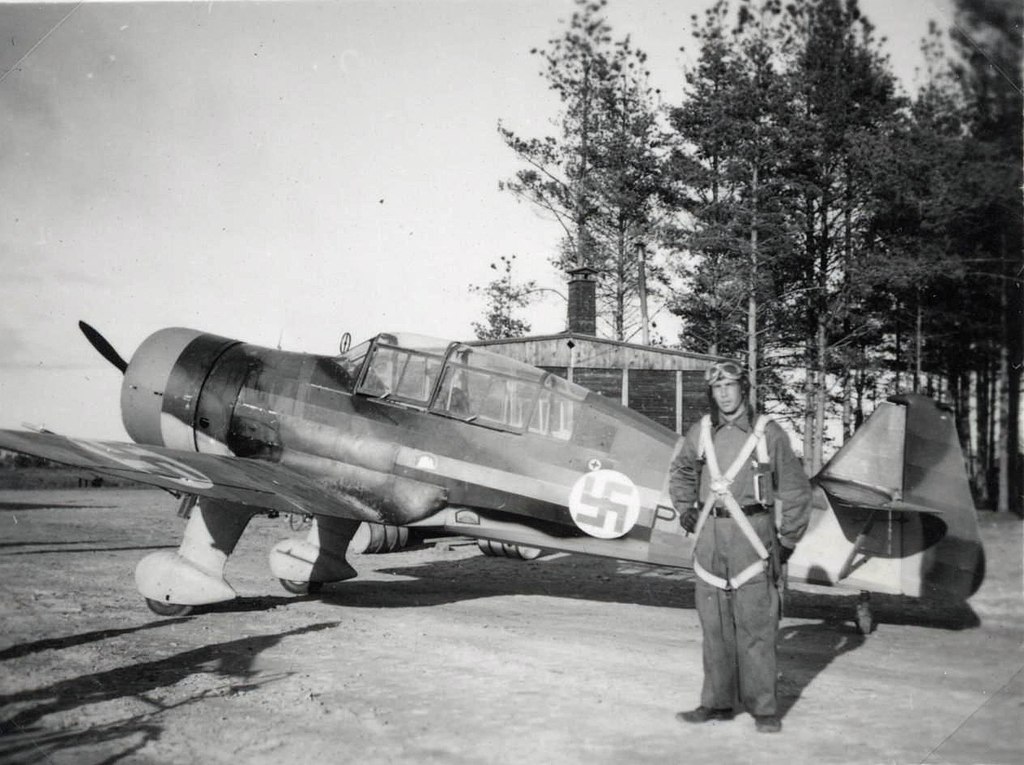
Actual combat action, Erik Lyly did not arrive until January 1942 after being ordered to 24.Squadron and more precisely for 3rd wing (3./24 LeLv). From January 1942 he flew with the Brewster B-239 fighter Finland had bought From US during the winter War, but receiving only after the War in spring 1940. He mostly flew with the BW-374, which he shot down the two(2) enemy aircraft. He often flew as a wingman for Flight Master Sergeant I.E. Juutilainen (highest scoring FinAF ace with 94 victories).

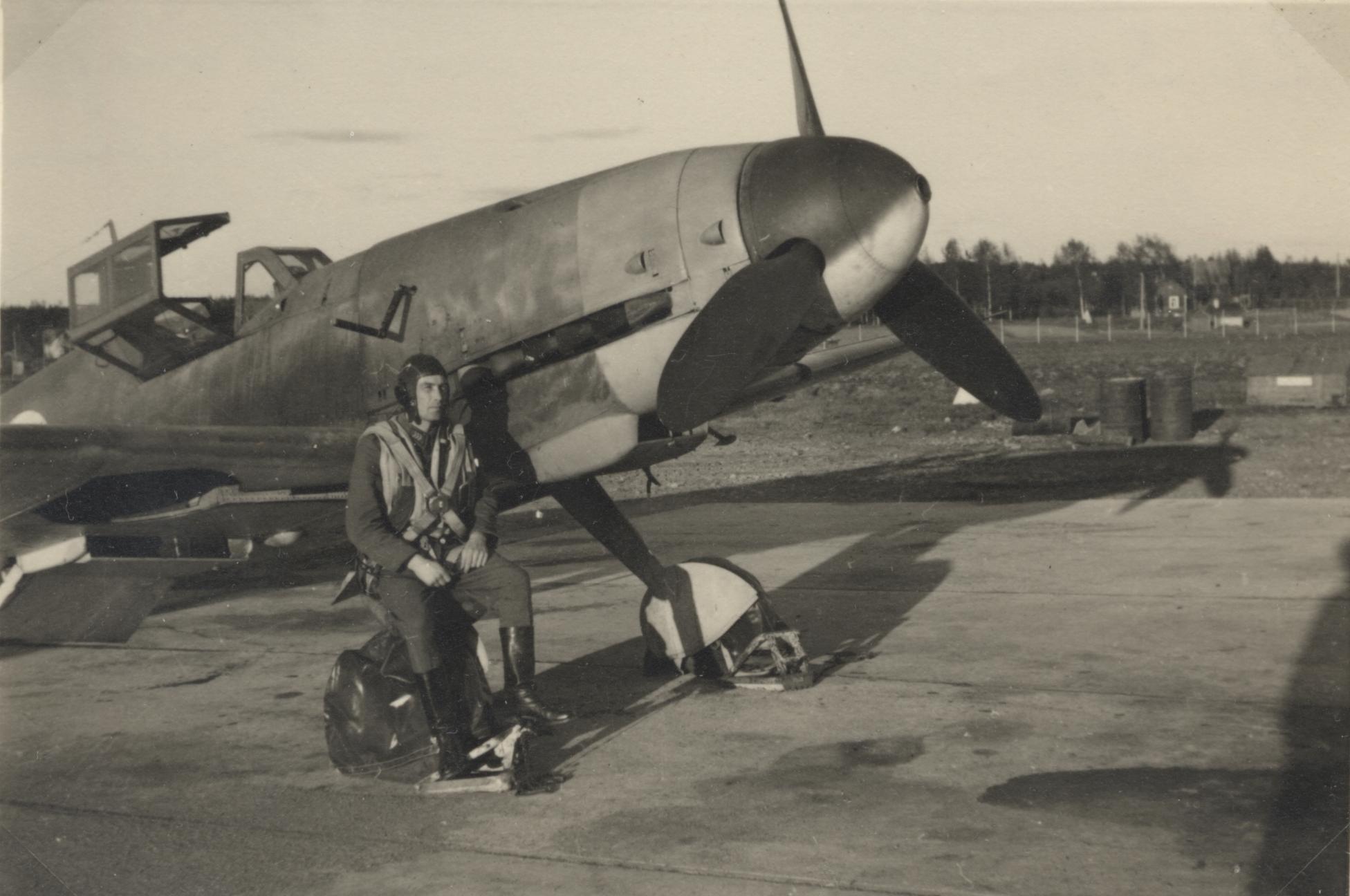
SSgt. E Lyly on top of his Me Bf 109G2, spring 1943, Utti AFB
In March 1943, he was transferred to the newly formed 34.Squadron (1./34.HLeLv), which was equipped with newly bought Messerschmitt Bf 109 G2 fighters. Squadron was equipped with updated G6-type on spring 1944. With them he achieved 6 air victories. In total, he completed 411 combat flights reaching to 8 confirmed (+9.5 unconfirmed) air victories.

SSgt. Erik Lyly with his Bf 109 G2 aircraft at Utti AFB, summer 1943
Erik Lyly never wounded, never needed to jump with a parachute during the war. The worst incident was an engine failure with DB 605 on 10.9.1943 that forced him to make a belly-landing for “AFB Jäppilä” (MT-207).
After the war, Lyly continued to work as a Service Manager for Pohjolan Liikenne Oy (bus depot), now in Ivalo, after Petsamo was lost to the Soviet hands. Two children were born Hannu (-47) and Hannele (-48). In 1949 he moved to Rovaniemi and set up an aviation company Lentokuljetus Oy together with his war mechanics. The company acquired one Karhumäki Karhu 48B single engine plane,[10] manufactured only in two (2) examples (OH-VKK and VKL). The company owned plane was OH-VKK and it was the first individual in the series.

Karhumäki Karhu 48B of Lentokuljetus Oy with floats,1950
The company operated throughout Finland, but mainly in the Lapland area, carrying out both passenger and freight. When the plane was rented in February 1950, it went over the nose, when taking off from the river and was badly damaged. Two more children were born in Rovaniemi days, Erkki (-57 and Ilkka -61). Erik Lyly continued as a store manager for Aineen Autoliike Oy (car dealer) in Rovaniemi. Later on he founded a new company Polar Auto Oy / AutoRova Oy (car dealer) as a shareholder and managing director of his own car store.
Company had a Sisu, Vanaja, Land-Rover, Triumph and Renault brands in Northern Finland. He also drove ice racing with a Renault-Gordini car.

Fuelling up PZL 101 Gawron of Metsälento Oy for forest dusting, 1966
He returned to aviation again in 1968 when he started as a pilot for Metsälento Oy (agricultural dusting). The company operated in Lapland with a PZL 101 Gawron type (OH-GAC). The pilot's career continued with Tunturilento Oy as a pilot from 1968 and he moved to the company's headquarters in Haaparanta, Sweden. The company operated in Lapland carrying out passenger and freight operations with several aircraft types. Among others Cessna 185 floats and Cessna 310 types (OH-CNI, OH-CBC). He maintained a VFR / IFR, multi-engine and float plane ratings. He retired from this task 1975.


He liked recreational aviation as well, as he had done all his life in Rovaniemi with Lapin Lentäjät R.y (Association of Lapland Pilots) with Piper PA-28 and Cessna 152 types. Erik Lyly died at his home peacefully in Haparanda, Sweden at the age of 75 years. He is buried at the Haaparanta (Haparanda, Sweden) church cemetery.

![Kuvahaun tulos haulle Lauri Nissinen Born 31 July 1918 Joensuu Died 17 June 1944 (aged 25) Kaukjärvi Allegiance Finland Service/ branch Finnish Air Force Years of service 1939–1944 Battles/wars World War II Winter War Continuation War Lauri Nissinen (31 July 1918 in Joensuu – 17 June 1944 in Kaukjärvi ) was a World War II flying ace in the Finnish Air Force . [1] Contents 1 Biography 2 See also 3 References 4 External links Biography [ edit ] Nissinen achieved 22 of his victories while piloting a Brewster B-239 Lauri Vilhelm Nissinen was born in Joensuu on 31 July 1918 and for his compulsory military service joined the Air Force, during which time he decided on flying as a career, applying for NCO pilot training in 1938. Due to his performance during training he joined HLeLv 24, flying the Fokker D.XXI in May 1939. In summer 1939 he was promoted to Sergeant. As the Winter War broke out, Sgt. Nissinen first claimed an air victory on 1 December 1939, claiming a SB-2 shot down and damaging two others over Viipuri . By the end of the Winter War he had claimed four victories in total and was a Sergeant Major. HLeLv 24 then equipped with the US- built Brewster Buffalo . As hostilities broke out again on 25 June 1941 Nissinen again flew operationally. On 7 July 1941 over Käkisalmi two enemy fighters attacked head-on, Nissinen shooting down both. On 21 July 1941 he again shot down a I-153 in a head-on battle, although his aircraft was damaged and he returned to base. His ground crew found four hits in the engine, one in the prop and several more in the wings. On 1 August 1941 at Rautjärvi six Buffalos engaged eight Soviet I-16 fighters, Nissinen's target exploding and its debris damaged Nissinen's right wing. Three I-16s attacked from behind and his fighter took several hits, shattering the windscreen. At the end of 1941 Nissinen was the second highest scoring FAF ace with 15.5 kills. Early in 1942 Nissinen attended Officer Cadet School, from where he then graduated in June 1943 as a Lieutenant. Nissinen was awarded the Mannerheim Cross on 5 July 1942, his number being 69. He held the rank of vänrikki at the time. [2] Returning to HLeLv 24 Nissinen was made a flight commander and resumed flying missions. His score increased to 26 by the end of 1943. The squadron gradually re-equipped with Messerschmitt Bf 109 fighters in spring 1944. In May 1944 HLeLv 32, flying the Curtiss P-36, was temporarily strengthened with a Messerschmitt Bf 109G-2 flight commanded by Lt. Nissinen. On 16 May Nissinen scrambled against a single Lavochkin La-5 approaching Nurmoila . The La-5 circled at 1500 m and allowed Nissinen climb to the same altitude before turning to attack from above, shooting down the La-5 after a series of exhausting attacks. With the renewed Soviet offensive on 9 June 1944 Lt. Nissinen scored two more victories on 17 June 1944 as two flights intercepted Soviet Il-2 ground attack aircraft attacking Finnish positions at Kaukjärvi . Nissinen's wingman, Sgt. Heimo Lampi saw the crippled Messerschmitt of Lt. Sarjamo dive through the cloud and collide with Nissinen's plane. Both planes exploded on impact and the pilots were killed. Nissinen flew some 300 missions and scored 32 victories in total. [3] His grave is in Valkeala . See also [ edit ] Finland portal List of World War II flying aces List of World War II aces from Finland References [ edit ] Jump up ^ Lauri "Lapra" Nissinen Archived 2009-10-15 at the Wayback Machine . Jump up ^ Hurmerinta, Ilmari; Viitanen, Jukka, eds. (1994). Suomen puolesta: Mannerheim-ristin ritarit 1941–1945 [ For Finland: Knights of the Mannerheim Cross 1941–1945 ] (in Finnish). Ajatus. p. 253. ISBN 951-9440-28-3 . Jump up ^ Stenman, Kari (2000). "Lauri Nissinen, Mannerheim-ristin ritari 69" [Lauri Nissinen, Knight of the Mannerheim Cross 69]. Suomen ilmailuhistoriallinen lehti (in Finnish) (1): 11. External links [ edit ] Lauri Nissinen at Sci.fi Categories : 1918 births 1944 deaths Finnish aviators Winter War pilots Finnish World War II flying aces Finnish military personnel killed in World War II Aviators killed in aviation accidents or incidents People from Joensuu Knights of the Mannerheim Cross Navigation menu Not logged in Talk Contributions Create account Log in Article Talk Read Edit View history Search Search Wikipedia Go Main page Contents Featured content Current events Random article Donate to Wikipedia Wikipedia store Interaction Help About Wikipedia Community portal Recent changes Contact page Tools What links here Related changes Upload file Special pages Permanent link Page information Wikidata item Cite this page Print/export Create a book Download as PDF Printable version Languages í•œêµì–´ Suomi Edit links This page was last edited on 2 February 2018, at 03:14 (UTC) . Text is available under the Creative Commons Attribution-ShareAlike License ; additional terms may apply. By using this site, you agree to the Terms of Use and Privacy Policy . Wikipedia® is a registered trademark of the Wikimedia Foundation, Inc. , a non-profit organization. Privacy policy About Wikipedia Disclaimers Contact Wikipedia Developers Cookie statement Mobile view](https://upload.wikimedia.org/wikipedia/commons/9/93/Lauri_Vilhelm_Nissinen.jpg)